
 Let's Talk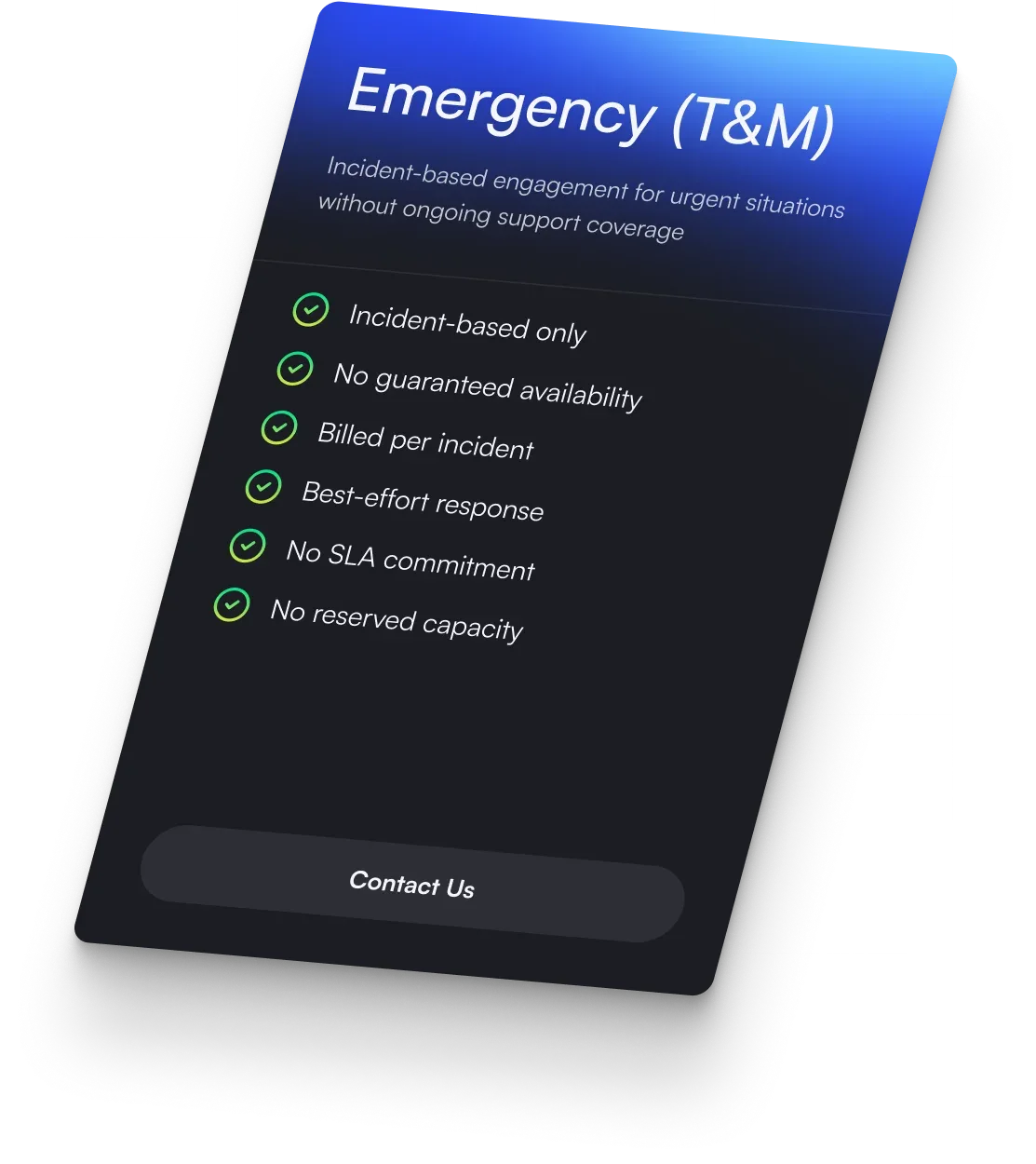

Issue Investigation
Investigation, diagnosis, containment, and reasonable corrective action for production issues affecting supported systems.
Predictable Support. Controlled Escalation. Clear Expectations.
A defined support framework ensures operational stability, predictable response times, and controlled escalation — so your team always knows who's responsible, how fast they'll respond, and what happens next.
Support scope applies to agreed and supported systems only. DevsX support typically includes:
Investigation, diagnosis, containment, and reasonable corrective action for production issues affecting supported systems.
Identification and correction of defects within existing supported functionality, including appropriate testing and validation.
Proactive software monitoring, clear incident ownership, fast alert response, structured escalation, and transparent client communication.
Preventive reliability and security work within the available support capacity, helping supported systems remain stable, secure, and operational.
Unless explicitly agreed separately, support does not include:
Building new features or custom functionality beyond the currently agreed scope of work.
Significant structural changes to the existing codebase, as opposed to incremental fixes and improvements.
Rebuilding or redesigning infrastructure from the ground up, rather than maintaining what's already in place.
Systems, services, or components owned and managed by 3rd parties outside our direct control.
Continuous, round-the-clock infrastructure monitoring and alerting as a standalone service.
Proactive performance tuning or optimisation initiatives that go beyond resolving an active incident.
Additional activities may be scoped separately under project or T&M engagement.
Flexible support options designed to match your operational needs, risk profile, and business clarity.
Incident-based engagement for urgent situations without ongoing support coverage
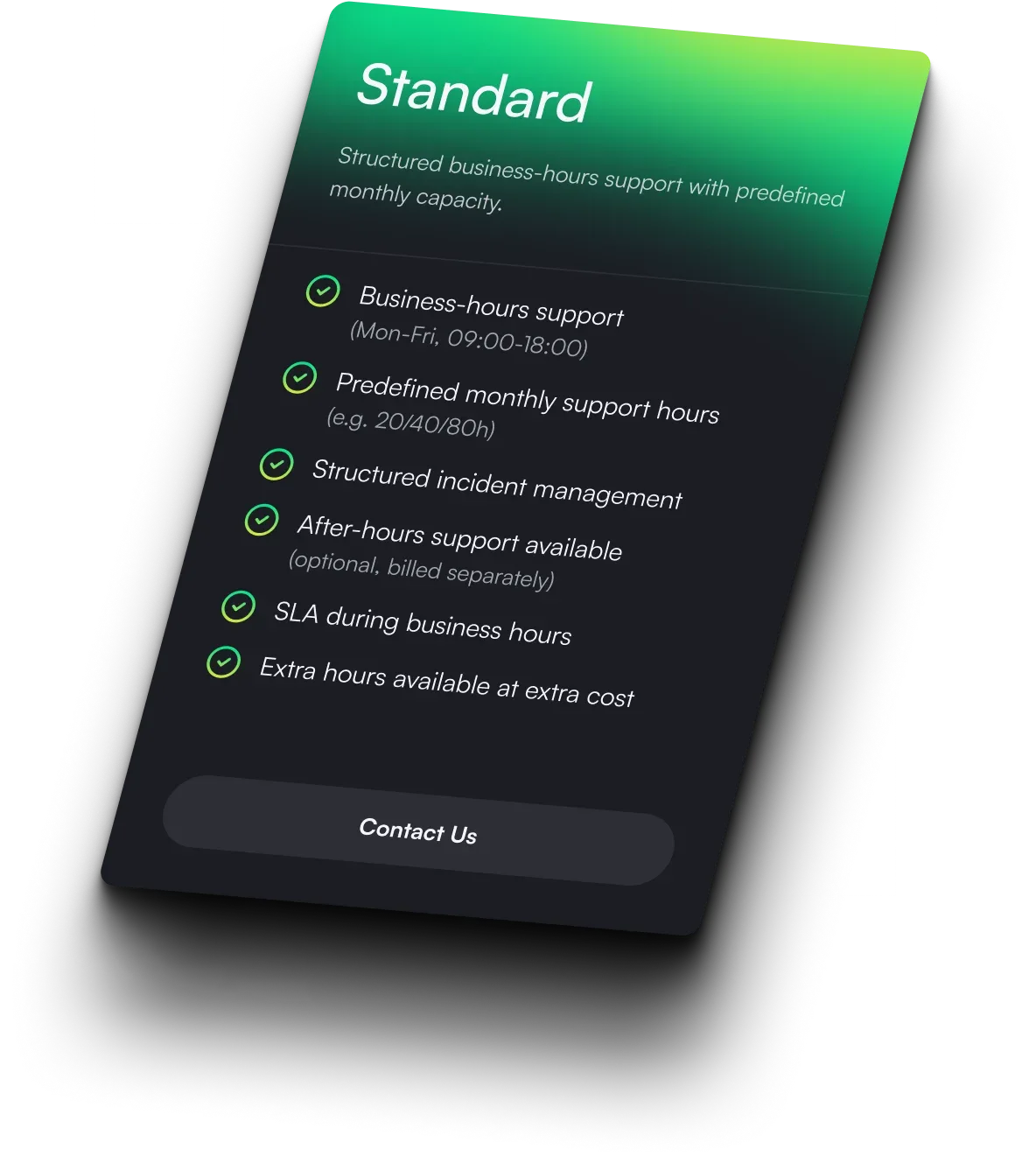
Structured business-hours support with predefined monthly capacity.
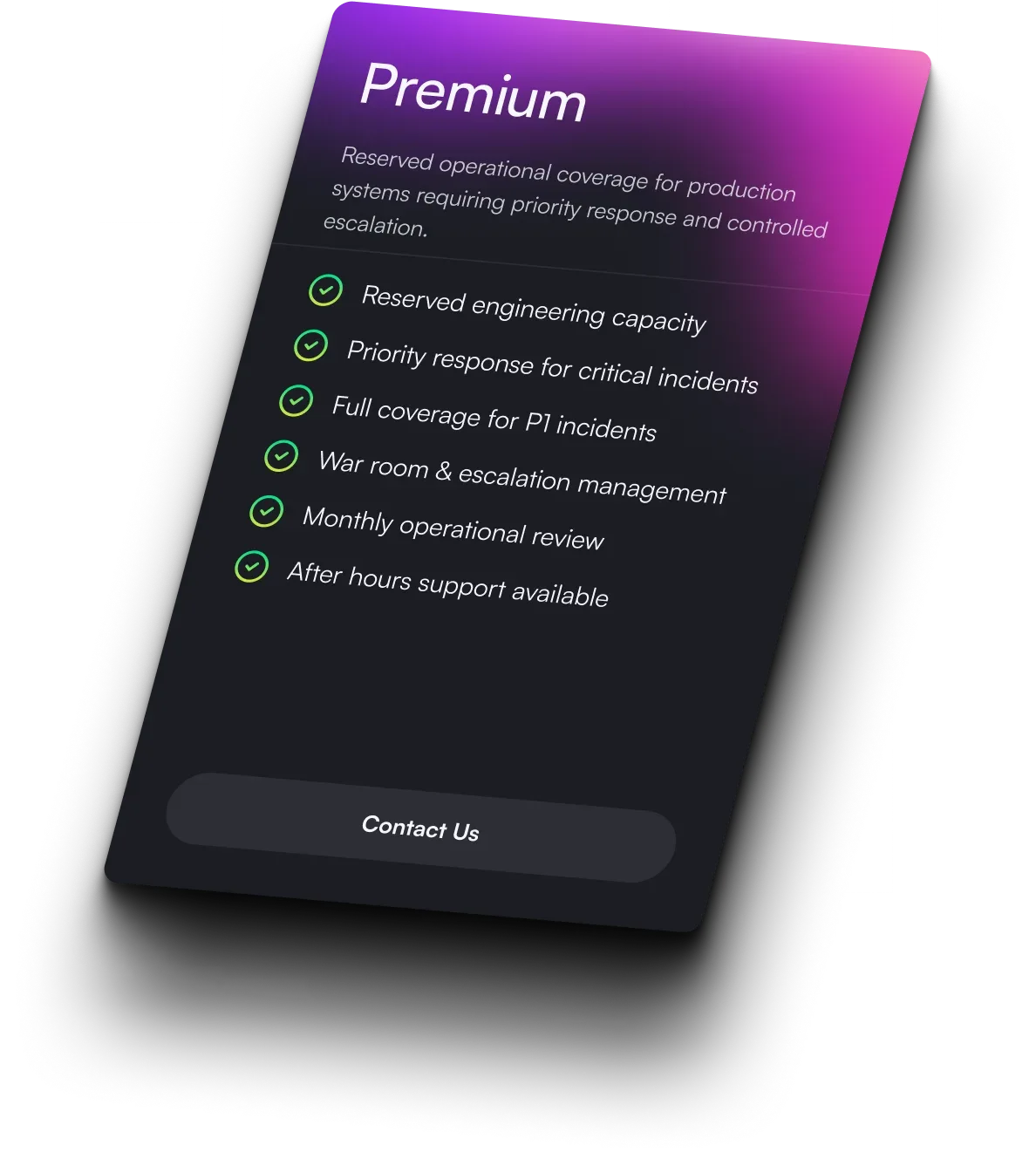
Reserved operational coverage for production systems requiring priority response and controlled escalation.
Additional activities may be scoped separately under project or T&M engagement.
Response time refers to initial acknowledgement and engagement, not full issue resolution — the moment we start working the problem, not the moment it's fully closed out and verified.
Response time is the time to acknowledge and start working on the issue. Resolution time depends on complexity, dependencies, and third-party factors that aren't always within our control — so we're upfront about the difference rather than promising what we can't guarantee.
Premium Support includes an after-hours response target of up to eight hours for P1 incidents. Standard and Emergency clients may request after-hours assistance, but acceptance depends on team availability and no response target is guaranteed.
After-hours handling of P2 incidents is available on request, subject to approval and team availability. No response target applies outside business hours, and any approved work is billed separately.
Different coverage levels based on time and incident severity.
09:00 - 18:00
(DevsX Time zone GMT+3)All incident severities supported with defined response targets
18:00 - 09:00
(DevsX Time zone GMT+3)Limited capacity available. Response time may be extended. Emergency conditions apply.

We Respond. We Manage. We Resolve.
After-hours support. is provided for critical incidents with extended response windows based on severity and availability.
A structured workflow ensures fast response, clear escalation, and reliable service restoration — from the moment an issue is first reported to the moment it's fully closed.
The issue is reported through the agreed support channels, formally logged, and tracked.
Business impact and urgency are assessed, and an appropriate severity level is assigned to determine the response and escalation path.
The responsible engineer or support team is identified and engaged without unnecessary delay.
A Tech Lead, DevOps specialist, Incident Commander, or additional engineers based on the technical impact and incident severity are involved when the severity and complexity of the incident require additional coordination.
Containment and restoration of critical service take priority, while DevsX coordinates communication, investigation, and required escalation in parallel.
The underlying issue is addressed, the solution is tested, and the system is operationally validated before the incident is considered resolved and verified.
The outcome is confirmed, documented, and communicated through the agreed channels, including any relevant follow-up actions for critical incidents.
DevsX support is guided by four operating principles, applied according to the scope and service level of the selected support package.
Each support package clearly defines its coverage, response targets, availability model, and limitations, so nothing is left to chance or guesswork.
Controlled escalation and prioritised incident handling, keeping critical issues from getting stuck behind minor ones in the queue.
Critical incidents handled under clearly defined rules within Premium model, not last-minute, ad-hoc decisions.
Clear ownership, clearly defined responsibilities, and consistent communication processes from start to finish.
testimonials

We found a reliable partner in DevsX. From the outset, their team demonstrated an unwavering commitment to our vision, delivering a functional app that perfectly matched our scope. As a startup with a fluctuating budget and sporadic working style, we often pose a challenge to tech teams. However, DevsX embraced our unpredictability with grace and flexibility, adapting their strategies to accommodate our evolving requirements.
Our experience with DevsX has been nothing short of remarkable. Their dedication, expertise, and adaptability have not only delivered a product that meets our expectations but has also set a standard for what a collaborative tech partnership should look like. We are grateful for their contributions and look forward to future endeavors with this exceptional team.
Customers expect AI features in 2025. AI algorithms must be trained correctly to deliver expected results. ML development services from DevsX ensure your AI features work as intended.
A structured support model gives your team clear ownership, better response expectations and fewer surprises when production issues happen.